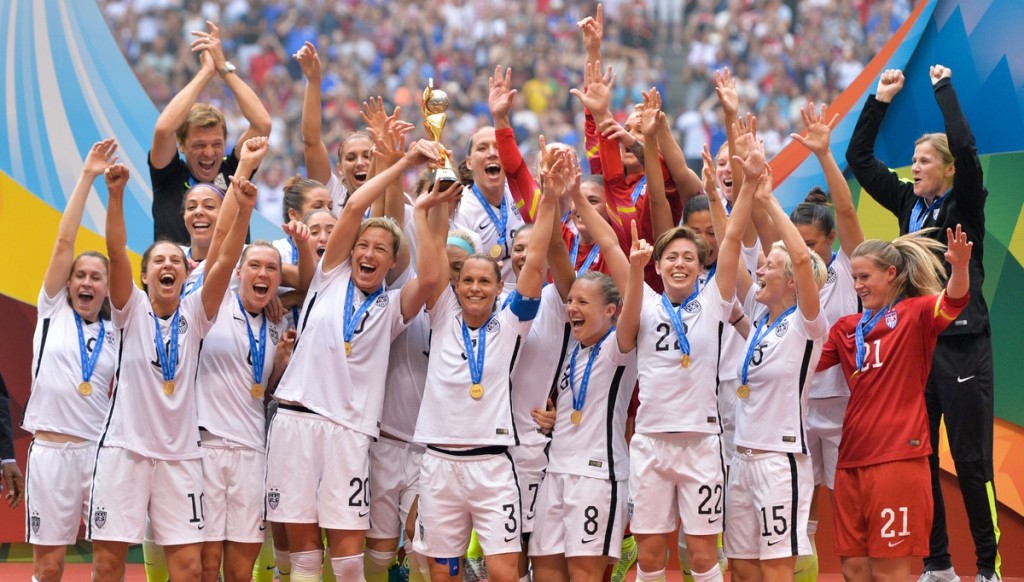
Woohoo! In a fitting cap to Independence Day weekend, the U.S. Women’s National Soccer Team won the FIFA World Cup Championship in a decisive 5-2 victory over Japan on July 5. Ridgefield Democrats join all Americans in celebrating this great team! Their outstanding victory is a product of the dedication, skill, and competitiveness of the team’s members and coaches. We congratulate each and every one of them for their exceptional achievements and abilities, in which all Americans take immense pride and joy.
With this victory, the US Women raised their record to an unmatched three World Cup championships (including the first ever Women’s World Cup in 1991), along with four Olympic gold medals and ten Algarve Cup championships. Sustained success in any sport, in any division, at any level of play, depends upon the institutional infrastructure behind the team. For women’s sports in the US, that infrastructure would not be nearly as robust, nor possibly even exist, were it not for the 1972 passage Title IX of the Civil Rights Act which states, in part:
No person in the United States shall, on the basis of sex, be excluded from participation in, be denied the benefits of, or be subjected to discrimination under any education program or activity receiving federal financial assistance.
Co-authored by two progressive Democrats, Congresswoman Patsy Mink of Hawaii (for whom the act was posthumously renamed in October 2002) and Senator Birch Bayh, Jr. of Indiana, Title IX has been instrumental in the transformation of U.S. women’s sports and education. The transformation has been decades in the making, and is far from complete, but in 1972, and for years after, athletic and sports opportunities for girls and women were extremely limited at all levels. There were of course, great women’s tennis, gymnastics, and ice-skating champions of those years, but those competitors and their sports were not accorded the public financing and support that male-dominated sports have continuously enjoyed.
For example, the popularity and commercial success of men’s basketball has always been undergirded by the networks of public school and public college/university leagues that trained and developed male players from elementary school through college. Until the early-1990s, the dominant US Olympic teams were recruited exclusively from public colleges and universities. Publicly financed interscholastic and intercollegiate leagues not only created the foundation for a multi-decade string of Olympic medal teams, but also propelled the National Basketball Association’s (NBA) commercial success by delivering a steady stream of marquee players and eager fans.
Owing to overt gender discrimination, comparable public networks for women’s sports did not exist prior to Title IX. Indeed, until Title IX became law, large numbers of states specifically prohibited interscholastic competition in women’s sports. Without comparable public financing, the market for women’s sports remained perpetually under-developed. Opponents have incorrectly portrayed Title IX as subsidizing women’s sports for which no free market demand exists; in truth Title IX successfully extended to women’s sports a portion of subsidies which have been continuously extended to men’s sports. As with men’s sports, the subsidies preceded and accelerated market demand, not the other way around.
In the language of economics, Title IX has partially ameliorated the “market failure” to adequately support and compensate girls’ and women’s sports. Only partially ameliorated, because that market failure continues to persist both within the purview of Title IX, but also well beyond its statutory reach. For example, the July 5 Women’s World Cup championship game drew record TV viewership for a U.S. soccer broadcast (both men’s and women’s), had a larger and more demographically-desirable (to advertisers) audience then the June 16, 2015, broadcast of the decisive game 6 of the NBA Finals (which drew largest broadcast audience of any NBA championship game since the 1990s), yet the Women’s World Cup attracted a fraction of the advertisers and advertising revenues of the men’s World Cup game or the NBA finals game, and the women’s World Cup championship prize money was a fraction of the participation money awarded to first round losers in the men’s World Cup tournament.
The fact that Title IX bolstered the foundation for the July 5 championship does not detract from that victory for women’s sports in America. In fact, the U.S. Women’s National Soccer Team underscores and vindicates the importance of Title IX in ensuring that dedication, hard work and raw talent at all levels and by all citizens will be supported and accorded the necessary opportunities to develop and produce such stupendous accomplishments. Thus, this World Cup championship is truly an all-American victory.