The recent town hall forum debate on economic issues was extraordinarily enlightening. The forum was part of a series of events that have been sponsored by Ridgefield’s Democratic Town Committee. The forums are free of charge and open to the public. The goal is to inform voters and to raise the level of debate. The latest forum featured panelists with very different points of view and drew a standing-room crowd of Democrats, Republicans, and unaffiliated voters. Economic issues are important to all of us.
One of the great pitfalls in the analysis of economics, to paraphrase Will Rogers, isn’t what we don’t know; it’s what we know for a fact that just isn’t so. How do we explain the low level of business investment? Is it because high taxes and onerous regulations have removed the incentives to invest? Or is it because business people, the ones who make investment decisions, don’t see investment opportunities? After all, if you own a factory, you’re not going to make large capital investments to expand the factory if you’re not selling all of the products you’re currently producing. (I remember that they were very strict on this point when I was in business school.)
So now we have two possible explanations: if you already believe that taxes and regulations are killing growth the first argument will resonate for you; and if you already believe that lack of demand is to blame you’ll be more disposed to the second one. By the way, this is a classic example of the difference between supply-siders and Keynesians.
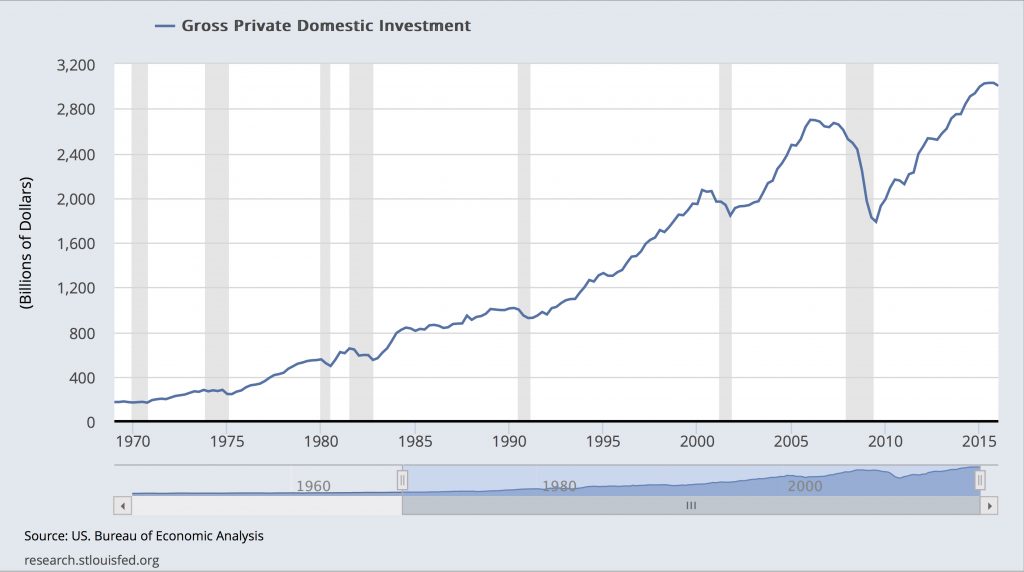
The problem with these analyses – but good news for the American economy – is that business investment isn’t stagnating. In fact, business investment is at an all-time high, $2.8 trillion in constant (inflation-adjusted) dollars. To put this number in context the overall economy is about $16 trillion, again in constant dollars. These data come from the Federal Reserve Economic Data (FRED) website.
The FRED data yield two other important insights. The first is that Gross Private Domestic Investment (or GPDI) is extraordinarily sensitive to growth or contraction in the Gross Domestic Product (GDP). A 1% contraction in GDP can lead to a 4% decline in GPDI, while a 1% rise in GDP can lead to 4% rise in GPDI. The second is that average annual GPDI rates of growth are much higher when Democrats have controlled the White House:
- 1961-1968 – Kennedy-Johnson +2.1%
- 1969-1976 Nixon-Ford +0.9%
- 1977-1980 Carter +1.4%
- 1981-1992 Reagan-Bush + 0.7%
- 1993-2000 Clinton +1.8%
- 2001-2008 Bush -0.5%
- 2009-2016 Obama +2.4%
We can’t assign all of the credit or all of the blame to presidents for the changes in investment that occur during their administrations. However, we can say with some assurance that the perennial GOP prescription of cutting taxes and gutting regulations doesn’t unleash business investment.
The Ridgefield Democratic Town Committee provides this column.